

Allowing for the “artificial.”
Why my kids will always have access to all the things…

First off, thank you so much to
for getting writers together to debate in longform. Such a cool idea, so needed! I connected with him about writing a piece on why I am totally fine with giving my kids all the foods and I don’t really stress too much about the types of sunscreens, soaps etc. that they use. There is too much fretting in the parenting world, I just can’t.Maybe as school starts we all need a good reminder that our kids have a lot going on and so do we. Our plates are full— reducing stress in small ways is key….
Parenting is hard. Especially in this particular moment where we are inundated with not only options in what we feed our children, but also very strong opinions around such choices. These options and opinions can make feeding our children feel like a zero sum game. Get it “wrong” and doom your children to an unhealthy life—whatever that even means.
I am a licensed psychologist and certified eating disorder specialist, which makes me steeped in how difficult it is to navigate the world through a lens of rigidity. I am also a parent, I have two young children that I am raising to build as much resilience and flexibility in a world that is often dark and rigid. This is why…
I take the umbrella stance with my kids that “all foods fit” and I even extend that to not getting overly rigid or concerned about the products we use in our home or on our skin.
First off, I think it is important to operationally define a few terms. This whole debate on what products or ingredients are best is relatively new and therefore the landscape is incredibly murky. In the 70’s there were so few choices, that parents did not have to sort through so much information (and feelings). They just picked up whatever was available, threw it in an actual physical shopping cart, and moved on. Now we have shopping carts at the top of our screens, and the choices (and reviews) are endless.
The term “health” has largely been co-opted by the wellness industry and has become a watered down catch all term that can be incredibly vague.
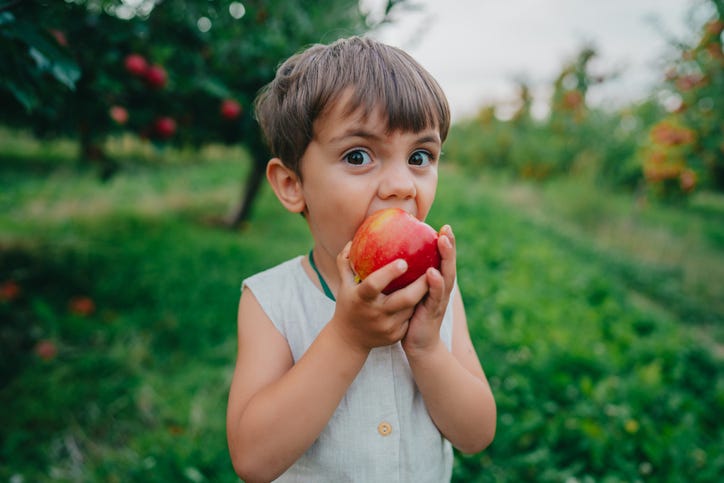
What I mean when I say “health” is broad as well, but I am focused on an overall measure of life. A quality of life that is full and expansive. Emotionally there is connection, contentment, and community. Physically there is play, joyful movement, and relaxation. What I don’t mean when I say “health” is weight or size. In fact, teaching my kids to approach bodies with neutrality is also something I am deeply passionate about as well!
The information landscape for parents is saturated with overwhelming amounts of information that happens to coincide with very confusing messages from the wellness world, making it nearly impossible to feel like what we feed our children won’t harm them (and this extends to what we put on them as well). This is why I work hard at neutralizing foods and other products.
Secondly, I work with clients who want to recover from disordered eating and build more flexibility in their lives (not just with food btw) and this informs so much of my approach with my kids.
So often, clients with a history of disordered eating have families who practiced rigidity around food. The food rules that many families adopt come from a good place and are often there to support the “health” of their children. Unfortunately, I see these practices as building fear around specific foods or ingredients. In fact, understanding one’s fear foods is often a part of the eating disorder recovery process.
Another phrase that is really confusing and worth operationally defining for purposes of this argument is, ultra processed foods. For the record, there is not much agreement on what an ultra processed food is—we sort of know it when we see it. So, I what I mean when I say ultra processed foods, are quick and convenient foods that are not the most nutritionally dense and not a “whole food.” I regularly feed my children ultra processed foods (I imagine many gasp at this) and I do not worry about how these will affect their physical health.
I actually worry so much more about my kids hearing messages about these foods being “bad” and then having to work on undoing the neutrality they have about all foods.
The fact is that we live in a world where our food systems might not be the best—I can definitely get behind the desire to improve our food systems and disentangle giant corporations bottom lines’ from the safety of our food. But this food is what we have to work with. We have busy lives—in case you were living under a rock, things are expensive and having two working parents is the norm these days. Sometimes ultra processed foods are all we will have time for—they have access to plenty of other foods too.
I am not a dietitian, but I am lucky to be in a field where I have access to loads of really great dietitians who recommend really great books to me. I remember first reading, “Child of Mine” by Ellyn Satter, and really sitting with my discomfort around my role as a parent; offer your child the choices, and then let them take it from there. My kids eat whole foods on a regular basis, but they also know that their snack shelves are perpetually stocked with a range of what many consider “junk foods.” They know they do not have to approach these foods with a scarcity mindset. In turn, I know that I am doing my best to instill a set of values that does not demonize any specific food or ingredient.
I truly believe that setting my children up to have a healthy relationship with food—one that is rooted in flexibility, enjoyment, and satisfaction means creating a foundation for them to have access to all the things.
The minute certain foods and ingredients become “bad” kids pick up on this and start to build rigidity around what they eat. When this rigidity enters the picture, so does SHAME. The last thing I want for my kids to have to deal with is feeling like they are bad for eating Doritos with their sandwiches. Or wanting to end their meals with something sweet. Or even not wanting broccoli (gasp again).
Completely agree with this! It's so odd when my kids friends come over and are shocked that there are no restrictions on what to eat or when to eat in our house. We have regular meals but we as the kids get older they also get to make their own lunch often. It's a great preparation for life because what is adulthood but having to make decisions about what to feed yourself every single day?!?